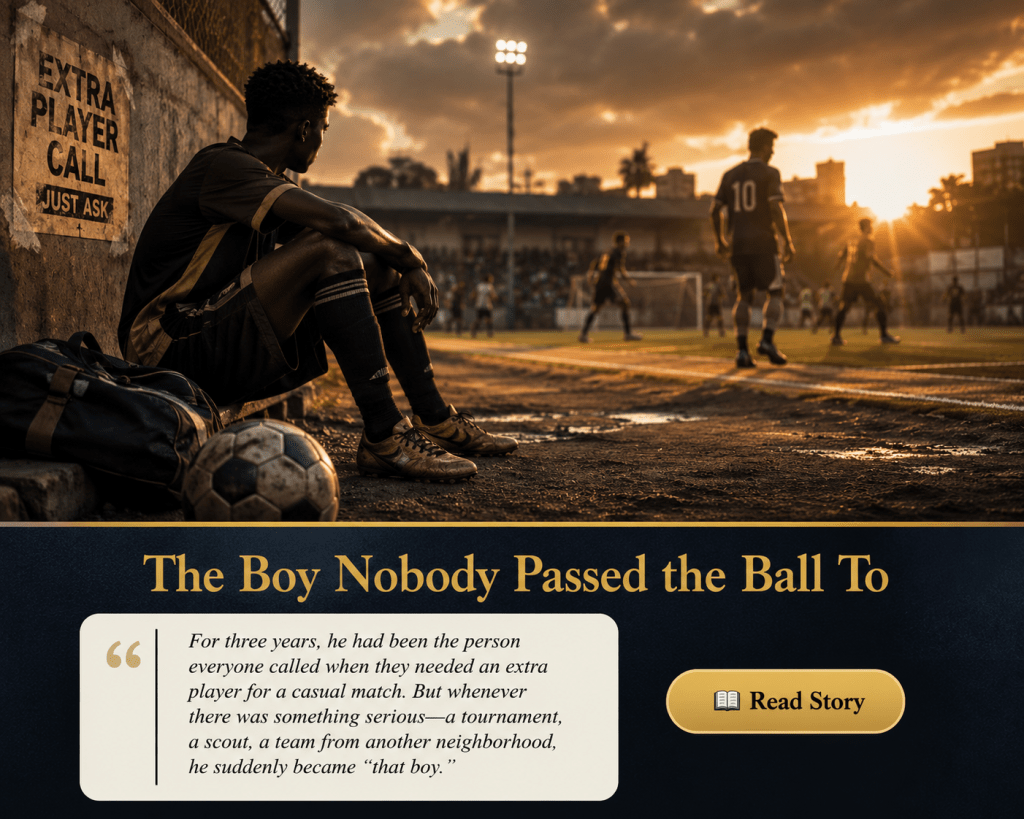
The Boy Nobody Passed the Ball To
The first time Emeka scored in front of two hundred people, nobody cheered.
Not because the goal wasn’t good.
They were simply too busy arguing about whether he was actually supposed to be on the pitch.
It was a Saturday afternoon at the community football field, and the annual Unity Cup had reached the semifinal. Emeka was twenty-four, worked at his uncle’s phone-accessories shop during the week, and spent nearly every free evening playing football with the same group of friends who had known him since secondary school.
Everyone knew Emeka could play.
The problem was that nobody important knew.
He had never played for a professional academy. He had no famous coach posting his videos online. He didn’t even own proper football boots. His current pair had been bought from a friend who insisted they were “almost new,” although one of them had already begun separating from its sole.
Still, Emeka had something the neighborhood defenders hated: he was fast, stubborn and annoyingly difficult to mark.
That Saturday, his team was losing 1–0 when their regular striker twisted his ankle.
The coach looked around.
“Who can play up front?”
Silence.
Then one of Emeka’s friends pointed at him.
“Let Emeka try.”
The coach frowned. “That boy?”
Emeka heard him.
So did everybody else.
He almost laughed.
For three years, he had been the person everyone called when they needed an extra player for a casual match. But whenever there was something serious—a tournament, a scout, a team from another neighborhood—he suddenly became “that boy.”
The coach finally waved him onto the pitch.
“Don’t try anything foolish.”
Emeka nodded.
Seven minutes later, the ball came toward him.
He controlled it, turned past one defender and crossed it to his teammate, who scored.
The crowd erupted.
Nobody remembered that Emeka had made the assist.
Ten minutes later, he received another pass near the box. This time he didn’t pass.
He shot.
Goal.
Now the crowd had completely lost its mind.
His teammates jumped on him. Someone threw a water bottle into the air. The coach was shouting his name as if he had personally discovered him.
After the match, three men approached Emeka.
One wanted him to play for another local team.
Another asked if he had a brother who played football.
The third simply said, “You should come and train with us on Tuesday.”
Emeka smiled.
For years, he had thought his problem was that nobody had discovered how good he was.
He was beginning to understand that wasn’t quite true.
People had noticed him.
They simply had no reason to trust him with something important.
The following week, Emeka went for the training session.
He expected everyone to welcome him like the hero from Saturday.
Instead, the coach barely looked at him.
“Carry those cones.”
Emeka stared at him.
Cones?
After scoring the winning goal and assisting another?
He almost walked away.
Then he remembered something his father used to say whenever Emeka complained that people didn’t appreciate him.
“If you want people to give you a chance, first give them a reason not to regret it.”
So Emeka carried the cones.
He arrived early.
He stayed late.
He helped collect the balls.
He listened.
When the coach needed someone to demonstrate a drill, Emeka volunteered.
When a younger player struggled with finishing, Emeka stayed behind and practiced with him.
Two weeks later, the coach asked him to play in a friendly match.
Emeka played well.
A month later, he was offered a small match fee.
It wasn’t much money.
But when Emeka held that first payment in his hand, he stared at it longer than he had stared at his football boots after buying them.
It wasn’t the amount that mattered.
Someone had finally decided that what he could do was valuable enough to pay for.
And that changed how he saw himself.
A few weeks later, a businessman who had watched him play approached him after a match.
“My son has been talking about your football,” the man said. “Can you train him twice a week?”
Emeka nearly said yes immediately.
Then he stopped.
“How much are you offering?”
The man looked surprised.
“You charge?”
Emeka smiled.
“I do now.”
He wasn’t suddenly famous. He wasn’t playing in Europe. He hadn’t become rich.
But he had crossed a line.
He had gone from being the talented boy everyone enjoyed watching for free to someone who understood that talent becomes an opportunity when you can demonstrate it, make people trust you, and confidently ask to be paid for the value you provide.
And strangely enough, his first paying client hadn’t come from an advertisement.
It had come from a football field where, for years, nobody had bothered passing him the ball.
Lesson
Your first client may not come because someone discovers you are exceptionally talented. Sometimes they come because you finally get one small opportunity to show what you can do. Don’t wait for everyone to recognize your ability before you begin. Find a problem you can solve, prove your value on a small scale, do the work well, and let that first opportunity create the evidence you need for the next one. Your first client isn’t just money in your pocket; it is proof that someone is willing to trust your ability enough to pay for it.

 investment4you
Leave a comment