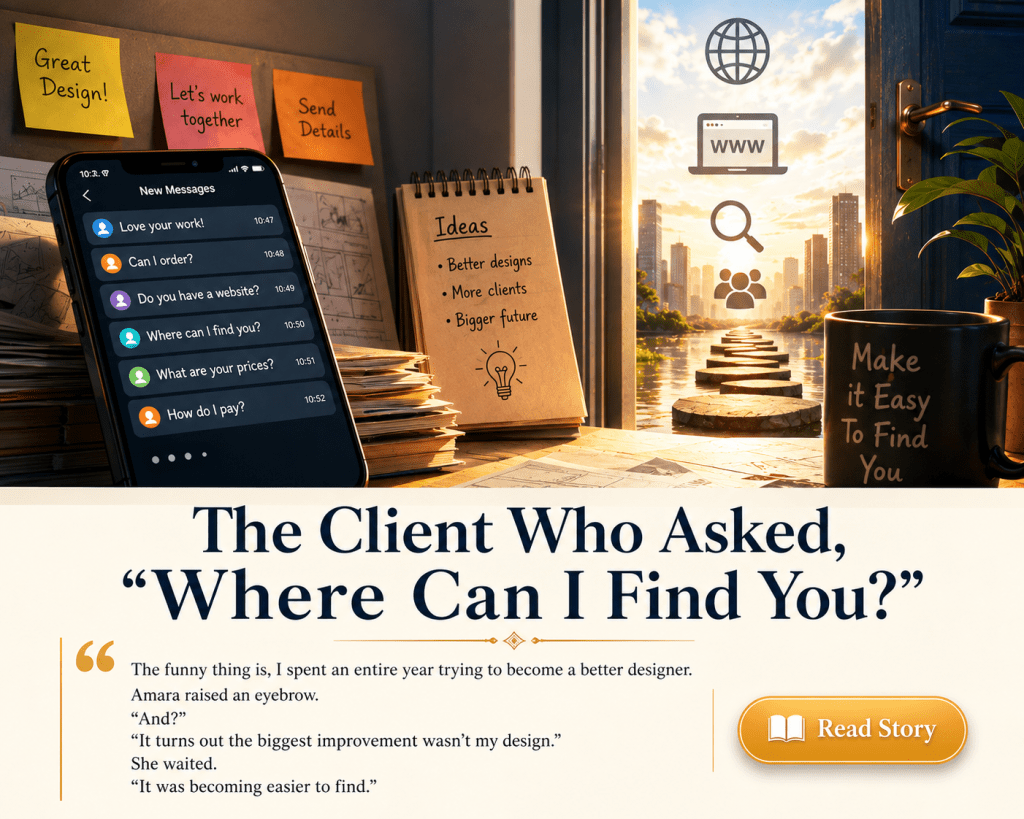
The Client Who Asked, “Where Can I Find You?”
The first time Tobi’s work went viral, he almost missed it because he was outside his apartment arguing with his internet provider. His phone kept buzzing while he stood in the compound waving his router in the air as though it had personally offended him. “What do you mean my data finished yesterday?” he grumbled. Between complaints, he glanced at another notification, then another, and another. Curious, he finally opened one. “Love your logo designs. Are you taking clients?” Another read, “Can I order a flyer?” Then came one that made him pause: “Do you have a website?” A smile spread across his face. At last, months of posting his designs every evening after work were finally paying off. But the smile faded just as quickly. He didn’t have a website. Hoping it wouldn’t matter, he replied, “Just send me a DM.” The customer started typing, stopped, and disappeared. They never returned.
By the end of the weekend, Tobi had received nearly forty messages from people who admired his work. Strangely, every conversation followed the same pattern. They complimented his designs, asked about hiring him, wanted to know where they could place an order, and then vanished after his replies. It was becoming a mystery. His younger sister, Amara, found him pacing around the sitting room looking thoroughly defeated.
“You look like someone who’s being haunted,” she joked.
“I am,” Tobi replied.
“By what?”
“Interested customers.”
Amara laughed, thinking he was exaggerating, until she picked up his phone. One customer had asked to see previous projects. Another wanted to know how payment worked. Someone else asked whether they could place an order without chatting first. Another simply wanted to see his prices. She looked back at him and shook her head. “Tobi… you’ve turned buying into an interview.”
She wasn’t wrong. Tobi wasn’t disorganized on purpose; he had simply built his business one shortcut at a time. His finished designs were scattered across his phone gallery. Client testimonials lived as screenshots buried inside WhatsApp conversations. Every time someone asked about prices, he typed them out from memory. Payments came through direct bank transfers, invoices were Word documents, receipts were screenshots of credit alerts, and completed jobs were delivered by email. On more than one occasion he had accidentally sent a client the wrong version of a logo because he couldn’t remember which file was final. Somehow, this patchwork system had worked well enough to keep him busy—until people who had never met him started trying to hire him.
A month later, Tobi met his former colleague, Ifeoma, for lunch. Between spoonfuls of rice, she smiled and said, “I heard you’re doing well with your design business.”
“I’m surviving,” he replied with a grin.
“I actually know someone looking for a designer.”
His face lit up immediately.
“Really?”
“Yes,” she said, “but there’s one condition.”
“Anything.”
“They don’t like ordering through DMs.”
Tobi frowned. “What do you mean?”
“They prefer hiring people through platforms.”
He looked genuinely confused.
“Platforms?”
“You know… somewhere they can see your work, your reviews, your prices, and exactly how you work without asking you twenty questions.”
He folded his arms dramatically. “So my WhatsApp isn’t enough?”
Ifeoma burst into laughter so hard she nearly spilled her pepper soup. When she finally caught her breath, she smiled and said, “Tobi, your WhatsApp is a conversation. A platform is a business.”
That single sentence stayed with him long after lunch. A conversation. A business. The words echoed in his mind the entire journey home.
The following evening, he decided to change things. Instead of dumping random designs online whenever he remembered, he carefully uploaded his best projects to a professional portfolio, organizing them into categories and explaining the problems each design had solved. He created profiles on freelance marketplaces, built a simple portfolio website, linked everything together, and wrote clear pricing guides so potential clients wouldn’t have to ask the same questions over and over again. It felt like a lot of work for something that wasn’t actually designing.
Then Monday morning arrived.
When Tobi checked his inbox, he found an email—not a direct message. “We found your portfolio and would like to discuss branding for our startup.” The email already included their budget, timeline, and company information. There was no endless exchange of greetings, no “Are you there?” messages, no disappearing customers. Everything he needed to begin was already there. He stared at the screen for a moment and laughed. He was so happy he considered framing the email.
From that point on, business began changing in ways he hadn’t expected. Clients stopped asking if he was legitimate because they could already see proof of his work. People found him through online searches instead of waiting for his posts to appear in their feeds. Existing clients recommended him by sharing a single link instead of forwarding screenshots from old chats. One customer even admitted, “I almost hired someone else because I couldn’t tell if you were still designing.” Tobi hadn’t stopped designing at all. He had simply hidden all his best work inside private conversations where no new customer could ever discover it.
Several months later, Tobi accompanied his aunt on a visit to one of her neighbors. Proudly introducing him, she said, “This is my nephew. He’s a graphic designer.”
The neighbor smiled warmly before asking the familiar question.
“Where can I find your work?”
Old Tobi would have unlocked his phone, searched endlessly through thousands of pictures, accidentally opened family photos, apologized for the confusion, found an unfinished logo instead of a completed one, promised to send better examples later, and probably forgotten before getting home.
This time, he simply smiled, handed over a small card, and watched the neighbor scan the QR code. Within seconds she was browsing his portfolio, reading client testimonials, comparing packages, and finding the inquiry form without asking a single question. She looked up and nodded.
“I’ll send you an inquiry tonight.”
She did.
A few weeks later, she became one of his biggest clients.
Months afterward, Amara walked into Tobi’s apartment carrying groceries. Books about business lined one side of the table, sticky notes covered the wall beside his laptop, and his once-chaotic schedule had become neatly organized. She smiled knowingly.
“So…”
“So?” he replied.
“How’s your haunted customer problem?”
He laughed.
“They still ask where to find me.”
“And?”
“I finally have an answer.”
He paused for a moment before smiling to himself.
“The funny thing is, I spent an entire year trying to become a better designer.”
Amara raised an eyebrow.
“And?”
“It turns out the biggest improvement wasn’t my design.”
She waited.
“It was becoming easier to find.”
Lesson
Being good at what you do is only half the journey. Opportunities often pass by not because your work lacks quality, but because people can’t easily discover it, trust it, or hire you. Whether you’re a writer, designer, developer, consultant, or entrepreneur, the right platforms don’t create your talent—they make your talent visible. Sometimes the difference between being overlooked and being fully booked is simply giving people a clear place to say, “I’d like to work with you.”

 investment4you
Leave a comment