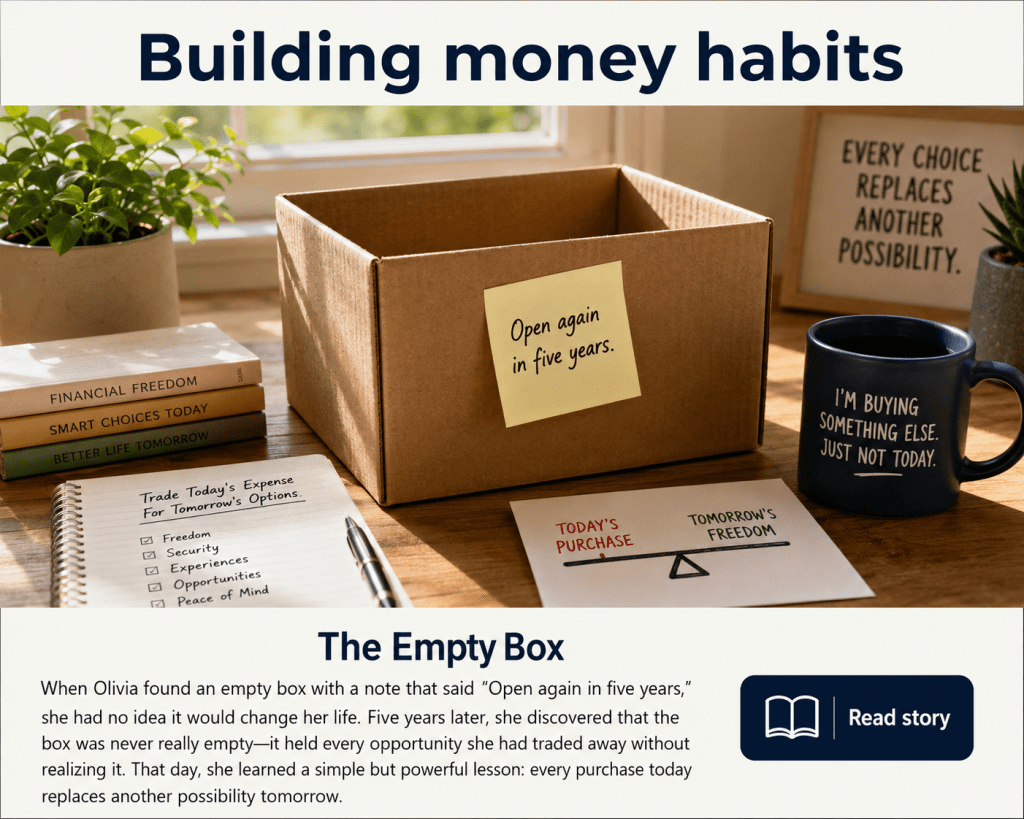
The Empty Box
When Olivia moved into her new apartment, she found a small cardboard box tucked away on the top shelf of the bedroom wardrobe. The previous tenant must have forgotten it. Curious, she climbed onto a chair, pulled it down, and opened it.
The box was empty.
Almost.
Inside was a single sticky note with five handwritten words:
“Open again in five years.”
Olivia laughed. “That’s impossible,” she muttered. “It’s already open.”
She crumpled the note, tossed the box into a corner, and forgot about it.
Life moved quickly after that. Like many young professionals, Olivia wasn’t reckless with money, but she wasn’t intentional either. She paid her bills on time, worked hard, accepted every salary increase with excitement, and rewarded herself whenever life became stressful. A difficult Monday deserved a fancy dinner. Finishing a project justified a shopping spree. A boring weekend called for scrolling through online stores until something interesting appeared at her doorstep.
None of it felt extravagant. In fact, every purchase seemed reasonable on its own. That was the problem. Nothing looked big enough to question.
Months became years, and her income steadily grew. Friends assumed she was doing well because she earned more than most people her age. Yet, every time an unexpected expense appeared, she found herself saying the same sentence.
“I just need one more paycheck.”
It became such a familiar phrase that even she stopped noticing it.
One Saturday afternoon, while reorganizing her apartment before renewing the lease, Olivia found the dusty cardboard box again. She almost threw it away until she remembered the strange note.
“Open again in five years.”
She smiled.
Exactly five years had passed.
For reasons she couldn’t explain, she sat on the floor with the empty box in front of her.
Then something unexpected happened.
She didn’t think about the box.
She thought about herself five years earlier.
Back then she had imagined that by now she’d feel financially comfortable. She pictured spontaneous vacations, investments growing quietly in the background, and enough savings that surprise expenses would simply be inconveniences instead of emergencies.
Instead, despite earning far more than she had five years ago, very little felt different.
Where had all those salary increases gone?
She wasn’t paying off some enormous mistake. She hadn’t made disastrous investments. She hadn’t lost money in a scam.
She simply couldn’t point to where thousands of small decisions had taken her.
That realization bothered her more than any financial setback ever had.
The following Monday, something unusual happened at work. During lunch, one of her older colleagues named Hassan declined an invitation to eat at a newly opened restaurant.
“I’m bringing lunch today,” he said, holding up a simple food container.
Someone joked, “Still saving money after all these years?”
Hassan smiled.
“No,” he replied. “I’m buying something else.”
Everyone looked confused.
“You didn’t buy anything,” another colleague laughed.
“I did,” Hassan answered. “Just not today.”
The conversation moved on, but Olivia couldn’t stop thinking about those words.
I’m buying something else. Just not today.
A week later she ran into Hassan again while leaving the office. This time curiosity got the better of her.
“What did you mean the other day?”
He smiled as though he’d been expecting the question.
“When people think about spending money, they only see today’s purchase,” he said. “I see the purchase that today’s decision is replacing.”
Olivia frowned.
Hassan pointed toward a nearby electronics store where customers crowded around the latest phones.
“Some of those people aren’t buying phones,” he said. “They’re exchanging next year’s freedom for today’s excitement. Others aren’t refusing to buy the phone. They’re choosing something they value more, even if they haven’t bought it yet.”
The words stayed with her for days.
She realized she had always treated money as though every decision existed on its own. Buy or don’t buy. Spend or don’t spend. She had never considered that every expense quietly replaced another possibility.
A pair of shoes could also be a weekend trip.
Daily food deliveries could become months of financial breathing room.
An impulsive upgrade could quietly postpone starting a business, changing careers, or taking time off when life became overwhelming.
For the first time, she stopped asking, “Can I afford this?”
Instead she asked, “What am I giving up if I say yes?”
The question changed everything.
Not overnight. There were still moments when convenience won. She still ordered food after exhausting days. She still treated herself occasionally. But the difference was that every decision became visible.
A few weeks later she almost bought a designer handbag she’d admired for months. Standing in the store, she imagined carrying it into work.
Then another thought appeared.
“If I buy this, what disappears instead?”
The answer surprised her.
Not money.
Options.
She walked out of the store empty-handed, not because the bag was bad, but because she suddenly preferred keeping her options.
Months passed, and something unexpected happened.
Her bank balance wasn’t just growing.
Her confidence was.
When friends invited her on a weekend trip, she said yes without checking whether payday was close.
When her car needed repairs, she paid without panic.
When an opportunity came to attend a professional conference she’d always wanted to visit, she registered immediately instead of wondering how to rearrange her finances.
None of those moments felt dramatic.
But together, they created a feeling she had never experienced before.
Space.
Financial space.
The freedom to make decisions without every choice being controlled by the next salary notification.
One evening, while packing for another move, Olivia found the little cardboard box for the third time.
It was still empty.
This time she smiled because she finally understood.
The box had never been empty.
For five years it had quietly held every opportunity she had traded away without noticing.
Every unnecessary purchase had placed something invisible inside it, a postponed dream, a delayed opportunity, or a little less freedom.
She found another sticky note and wrote five new words.
“What does this replace tomorrow?”
She placed it inside the box, closed the lid, and returned it to the top shelf.
Years later, whenever friends complained that they earned good salaries but never seemed to get ahead, Olivia never lectured them about budgets or percentages.
Instead, she told them about an empty cardboard box that had taught her the most valuable lesson she had ever learned.
Because building money habits isn’t always about learning how to save more.
Sometimes it’s about learning that every purchase quietly replaces another possibility, and the people who build lasting wealth aren’t always those who earn the most, they’re often the ones who become careful about what they’re willing to exchange for today’s comfort.

 investment4you
Leave a comment