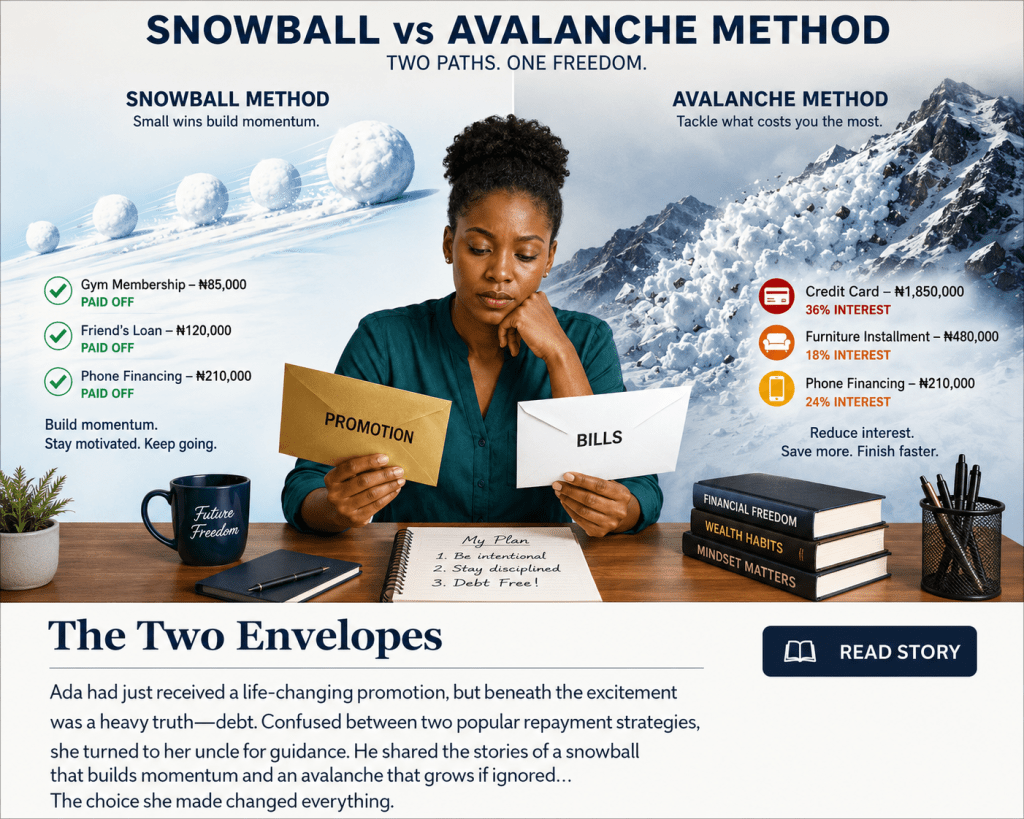
The Two Envelopes
The room erupted in applause.
“Congratulations on your promotion, Ada!”
Her colleagues surrounded her with handshakes, laughter, and promises of celebratory drinks. At twenty-nine, Ada had just become Operations Manager at one of Lagos’ fastest-growing logistics companies. Her salary had almost doubled.
She smiled.
She deserved this.
Or so she thought.
Three weeks later, Ada sat alone at her dining table staring at two envelopes.
The first was gold.
It contained her promotion letter.
The second was white.
It contained bills.
She spread them across the table.
- Credit card: ₦1,850,000
- Furniture installment: ₦480,000
- Smartphone financing: ₦210,000
- Gym membership arrears: ₦85,000
- Friend’s loan: ₦120,000
Total debt: ₦2,745,000.
She laughed.
Not because it was funny.
Because she honestly couldn’t remember how she’d managed to owe so many different people and companies.
The sofa.
The television.
The phone.
The vacation she’d convinced herself she deserved after “working so hard.”
The wedding outfit she’d worn exactly once.
None of them had seemed expensive individually.
Together, they looked like a financial crime scene.
Determined to fix it, Ada opened her laptop.
Search:
“Best debt repayment strategy.”
Immediately, hundreds of articles appeared.
Two names kept showing up.
Snowball Method.
Avalanche Method.
One promised quick motivation.
The other promised mathematical efficiency.
Both claimed to be the best.
Confused, Ada called the one person she trusted with money.
Her uncle, Chike.
Not because he was rich.
Because he’d once lost everything.
And somehow rebuilt it.
The next Saturday, they met at a quiet café.
Ada slid her list across the table.
“I don’t know where to start.”
Uncle Chike studied it for a moment.
Then he smiled.
“I’m going to tell you two stories.”
Story One: The Snowball
“Imagine you’re pushing a tiny snowball downhill.”
“It starts ridiculously small.”
“So small people laugh.”
“But every metre it rolls…
it gathers more snow.
It grows.
Gets heavier.
Moves faster.
Eventually…”
He paused.
“…it becomes impossible to stop.”
Ada nodded.
“I’ve seen videos.”
“That’s the Snowball Method.”
He pointed at her list.
“You ignore the size of the interest rate.”
“You attack the smallest balance first.”
Gym membership.
Then friend’s loan.
Then phone financing.
Then furniture.
Finally…
the credit card.
“Every time one debt disappears…”
He snapped his fingers.
“…you feel like you’ve won.”
One less payment.
One less reminder.
One less mental burden.
Momentum builds.
Confidence grows.
“The mathematics may not be perfect,” Uncle Chike said.
“But humans aren’t calculators.”
Ada leaned back.
“I like that.”
“Of course you do.”
“It’s emotionally satisfying.”
“But let me tell you the second story.”
Story Two: The Avalanche
“Imagine standing on a mountain.”
“A tiny piece of snow breaks loose.”
“It doesn’t look dangerous.”
“But as it races downhill…
it gathers speed.
Power.
Mass.
Until it becomes an avalanche.”
He picked up Ada’s debt list again.
“Interest behaves exactly like that.”
He circled the credit card.
“Suppose this debt charges 36% annually.”
Then the phone.
“Maybe this one is 24%.”
Furniture.
“Perhaps 18%.”
Friend.
“No interest.”
Gym.
“No interest.”
“The Avalanche Method says…”
He tapped the credit card.
“Destroy the fastest-growing debt first.”
Because while you’re paying off the tiny debts…
this giant one is quietly growing.
Like snow racing down a mountain.
Every month you delay…
the avalanche gets bigger.
“The Avalanche Method saves the most money.”
He paused.
“But…”
Ada smiled.
“There’s always a ‘but.’”
“…progress feels slower.”
Months can pass before you completely eliminate your first debt.
Some people lose motivation halfway.
Not because the strategy is wrong.
Because it doesn’t feel like they’re winning.
Ada stared at the list.
“So…”
“Snowball wins emotionally.”
“Avalanche wins mathematically.”
“Exactly.”
She was still undecided.
Until Monday morning.
At work, Ada watched two members of her team preparing presentations.
Emeka started with the easy slides.
One after another.
Each completed slide energized him.
By lunch…
he’d finished the entire presentation.
Grace did the opposite.
She attacked the hardest analysis first.
It took nearly five hours.
By afternoon…
she’d completed the most difficult section.
The remaining slides took less than an hour.
Both finished.
Both delivered excellent presentations.
Different strategies.
Same destination.
That evening, Ada had an idea.
She wasn’t choosing between Snowball and Avalanche.
She was choosing based on herself.
She asked herself one brutally honest question:
“What’s more likely to make me quit?”
Was it paying more interest?
Or feeling like I wasn’t making progress?
She already knew the answer.
She needed visible wins.
She needed proof that things were changing.
So she started with the gym membership.
Gone.
Then the loan from her friend.
Gone.
Then the phone financing.
Gone.
Each time a debt disappeared, she celebrated—not with spending, but by crossing another line off her list and transferring that freed-up payment to the next debt.
Months later, only the furniture installment and the credit card remained.
By then, something had changed.
She no longer needed motivation.
Momentum had taken over.
With fewer monthly payments to juggle, she directed every extra naira toward the high-interest credit card until it, too, disappeared.
The system that began with emotion ended with mathematics.
Nearly two years later, Ada opened another envelope.
Inside was a mortgage pre-approval.
The bank manager smiled.
“We’re impressed.”
“Your debt history shows something unusual.”
Ada raised an eyebrow.
“What?”
“You didn’t just repay your debts.”
“You built a habit.”
As she walked out of the bank, she remembered Uncle Chike’s words.
“The best repayment method isn’t the one that looks smartest on paper.”
“It’s the one you’ll still be following six months from now.”
Because a strategy only works if you stick with it.
Some people need the excitement of a snowball.
Others benefit more from stopping an avalanche before it grows.
Neither method is magic.
Both require discipline.
But the right method is the one that keeps you moving until every debt is behind you.
The Takeaway
If your biggest challenge is staying motivated, the Snowball Method can help you build confidence by paying off your smallest debts first. Every cleared balance gives you another win and frees up more money to attack the next debt.
If your biggest challenge is reducing the total cost of borrowing, the Avalanche Method is usually the better choice. By targeting the debt with the highest interest rate first, you pay less interest over time and become debt-free more efficiently.
The most effective debt strategy isn’t necessarily the mathematically perfect one—it’s the one you’ll consistently follow until the last balance reaches zero.

 investment4you
Leave a comment