Picture this: a crowded auditorium, the low hum of energy, and a spotlight hitting the stage. I walk up to the microphone, look out at a room full of sharp, ambitious young professionals, and say:
“I am not here today to tell you to stop buying lattes. I’m not here to tell you that buying a designer bag on a starter salary is a bad idea—because you’re all smart enough to already know that. Instead, I want to tell you the story of David.”
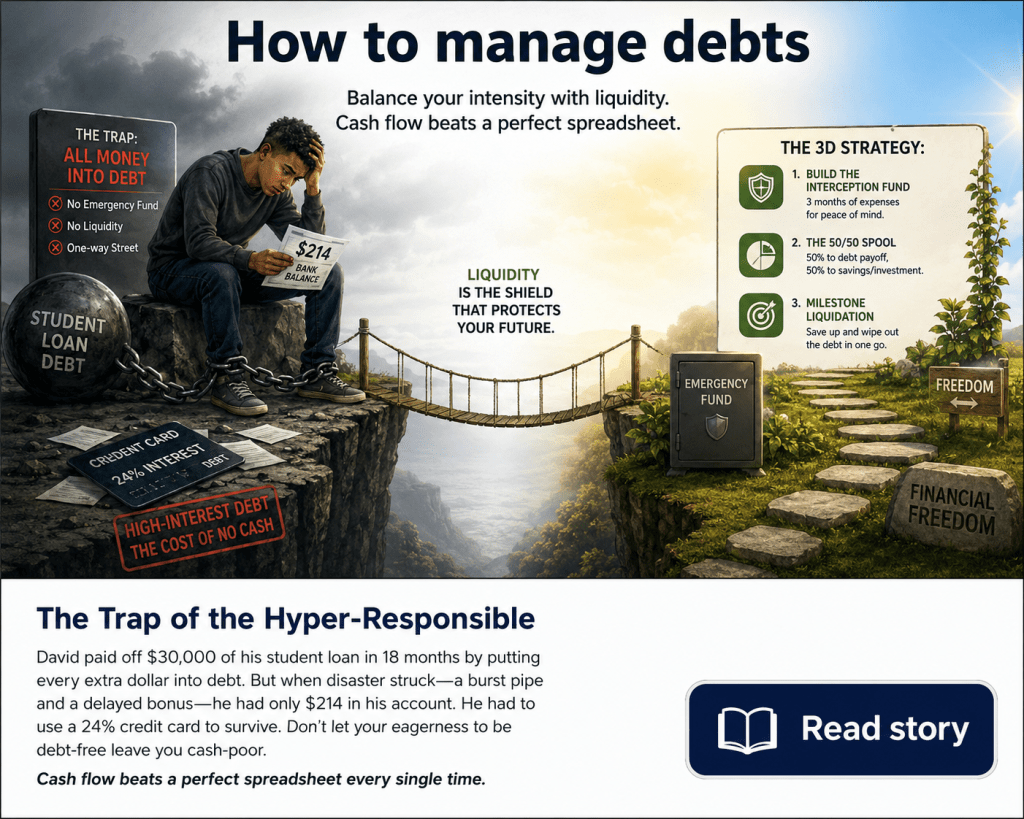
The Trap of the Hyper-Responsible
David was a rockstar. At 26, he was pulling in a great salary at a tech firm, living in a modest apartment, and driving a reliable used car. He didn’t have a spending problem; he had an ambition problem. David hated his $40,000 student loan balance. He viewed it as a tether holding him back from his financial freedom.
So, David made a plan. It was mathematically beautiful. He stripped his lifestyle to the bone. Every single month, after paying rent and buying basic groceries, he poured every remaining dollar—nearly $2,500 a month—straight into his student loans.
He didn’t build an emergency fund because he thought, “Why let cash sit in a savings account earning 1% interest when my debt is costing me 6%? That’s bad math.” He felt like a financial samurai, slashing away at his balance. Within eighteen months, he had chopped that $40,000 debt down to just $10,000. He was on top of the world.
And then, the music stopped.
The Night the Math Failed
It wasn’t a wild party or a luxury vacation that broke David’s strategy. It was a Tuesday.
First, his company announced a “strategic restructuring,” delaying everyone’s quarterly bonuses by six months. The next morning, David woke up to a puddle in his kitchen—a major pipe had burst, warped his flooring, and his landlord pointed to a clause in the lease making David responsible for the immediate deductible. Total cost: $3,500.
David checked his bank account. Because he had been funneling every spare cent into his loans, he had exactly $214 in cash.
He couldn’t call the student loan company and say, “Hey, I overpaid you by $30,000 over the last year, can I get $3,500 back for a few weeks?” That money was gone, locked in a digital vault.
Desperate and lacking liquidity, David had to do the one thing he swore he’d never do: he opened a brand-new credit card with a 24% variable interest rate just to cover the repairs and buy groceries until his next paycheck. In a flash, his hyper-aggressive attempt to get out of 6% debt forced him to take on high-interest 24% debt. He had starved his own cash flow.
The Hidden Flaw: Debt Payoff is an “Illiquid Contract”
What David fell into is what I call the Aggressive Payoff Starvation Trap. It’s the most dangerous mistake smart people make, because it feels like the right thing to do.
When you pay off debt, that transaction is a one-way street. You cannot retrieve that capital in a crisis. Many young professionals treat debt payoff as their savings account, failing to realize that liquidity (cash on hand) is the shield that protects your debt strategy.
Without a cash buffer, any aggressive debt payoff plan is just a house of cards waiting for a breath of bad luck.
The Speaker’s Playbook: The 3D Debt Strategy
If you want to manage debt like a seasoned CFO rather than a panicked amateur, you need to balance two opposing forces: lowering your liabilities while maintaining your liquidity.
- Step 1: Build the “Interception Fund”Before you pay a single dollar over the minimum payment on any debt, build a basic emergency fund (ideally 3 months of bare-bones living expenses). This cash is not “wasted” or losing to inflation; it is insurance that keeps you from reversing your progress.
- Step 2: The 50/50 SpoolOnce your buffer is set, take whatever extra money you have decided to allocate to financial goals and split it. Put 50% toward crushing the principal of your debt, and 50% into an accessible savings or investment account.
- Step 3: The Milestone LiquidationKeep paying the minimums and stacking that side cash. Once the cash pile in your savings account equals the entire remaining balance of your debt, you wipe it out in one single, glorious payment.
If David had used this strategy, the day his pipe burst, he would have simply taken $3,500 out of his growing savings cushion. His student loan payoff timeline would have slowed down by a couple of months, but he would have never had to touch a 24% credit card. He would have remained in total control.
The Takeaway: Don’t let your eagerness to be debt-free leave you cash-poor. In the real world, cash flow beats a perfect spreadsheet every single time. Balance your intensity with liquidity, and build a fortress that no unexpected Tuesday can tear down.

 investment4you
Leave a comment