Story Title: The Basket That Never Lies
Every Saturday morning, the market outside the neighborhood buzzed with life.
Vendors shouted prices.
Customers bargained loudly.
The smell of fresh bread drifted through the air.
For most people, it was just another shopping day.
For Amara and her older brother, David, it had become a weekly competition.
Who could return home with the best value?
Not the most expensive items.
Not the biggest shopping bag.
The best value.
The rules were simple.
Each received ₦20,000.
Each had to buy ingredients for dinner, breakfast supplies, toiletries, and one snack.
Whoever had the most useful shopping basket at the end won.
Amara was confident.
The moment she entered the supermarket, colorful displays pulled her in.
A tower of imported cereal.
A shelf of fancy fruit drinks.
A basket of beautifully packaged biscuits.
Everything looked amazing.
She tossed item after item into her trolley.
“If it looks good, it must be good,” she whispered.
David walked much slower.
He rarely looked at the colorful displays.
Instead, he looked at the small white price labels underneath.
Then he turned each product around.
He read something on the back.
Sometimes he smiled.
Sometimes he quietly returned the item.
Forty minutes later they met at the checkout.
Amara’s trolley looked impressive.
David’s looked…ordinary.
She laughed.
“Are you sure that’s all you’re buying?”
He smiled.
“I bought what I came for.”
Back home, their aunt, who was the judge, emptied both shopping bags onto the dining table.
She picked up the cereal from Amara’s bag.
“Why did you choose this?”
“It looked healthier.”
Her aunt compared it with another cereal David bought.
David’s had more whole grains, less sugar, and cost ₦1,500 less.
Next came tomato paste.
Amara had bought three small tins.
David bought one large tin.
His aunt calculated the prices.
The three small tins cost almost ₦900 more than the larger one, even though they contained nearly the same amount altogether.
Amara blinked.
“I never noticed.”
Then came tissue paper.
Amara bought a premium brand because the package looked luxurious.
David bought another brand with the same number of rolls and similar quality.
Again…
He paid less.
Finally, the cooking oil.
David surprised everyone.
He didn’t buy the cheapest bottle.
He bought the one with the lowest price per litre.
His aunt smiled.
“Now that’s smart shopping.”
Amara looked confused.
“Price per litre?”
Her aunt walked into the kitchen and brought out two empty bottles.
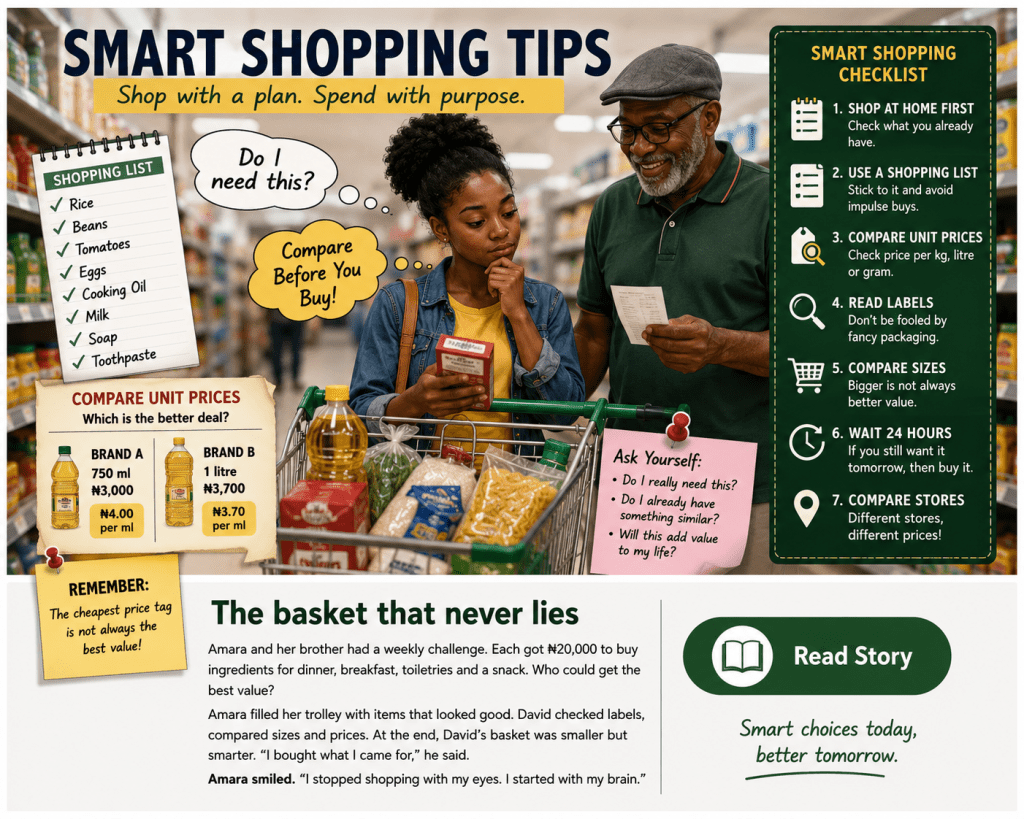
One contained 750 ml.
The other contained 1 litre.
“The cheaper bottle isn’t always the cheaper choice.”
She wrote on a piece of paper.
Bottle A
₦3,000 for 750 ml.
Bottle B
₦3,700 for 1 litre.
At first glance, Bottle A looked cheaper.
But after calculating the cost for each litre, Bottle B gave more oil for every naira spent.
Amara’s eyes widened.
“So I should compare the unit price, not just the total price?”
“Exactly.”
After lunch, David revealed his secret.
“I don’t actually shop inside the supermarket.”
Amara laughed.
“You were literally inside the supermarket.”
“No,” he said.
“I shop at home first.”
She frowned.
He opened the kitchen cupboard.
“I check what we already have.”
He opened the refrigerator.
“I see what’s running low.”
He checked the bathroom cabinet.
“I look at the toiletries.”
Then he showed her a handwritten shopping list.
“I only buy what’s on this list.”
“What if you see something interesting?”
“I take a photo.”
“A photo?”
“Yes.”
“If I still think about it after two days, I can always come back.”
The following Saturday they repeated the challenge.
This time Amara arrived with a shopping list.
She compared prices.
She checked labels.
She compared sizes.
She ignored products placed at eye level unless they truly offered good value.
She even bent down to check the lower shelves, where some of the better bargains were hiding.
At the checkout, she smiled.
Her basket looked smaller than last week.
But it contained everything she needed.
Nothing she didn’t.
Her aunt counted the savings.
Amara had spent ₦2,800 less than the previous week.
Yet she had bought more useful items.
“What changed?” her aunt asked.
Amara grinned.
“I stopped shopping with my eyes.”
“I started shopping with my brain.”
Months later, something unexpected happened.
Their kitchen had less waste.
Food expired less often.
Duplicate purchases almost disappeared.
Their grocery budget stretched further without anyone feeling deprived.
Amara realized that smart shoppers don’t spend the least.
They simply make every naira work harder.
And every shopping basket tells a story.
Some tell the story of impulse.
Others tell the story of intention.
Only one of those stories helps your money grow.
Smart Shopping Tips from the Story
- Shop at home first. Check your cupboards, fridge, and bathroom before making a shopping list.
- Always use a shopping list. It helps you focus on what you actually need.
- Compare unit prices. Look at the cost per litre, kilogram, or gram—not just the total price.
- Read product labels. Attractive packaging doesn’t always mean better quality.
- Compare different sizes. A larger pack is sometimes, but not always, the better value.
- Look beyond eye-level shelves. Better-value products are often placed higher or lower.
- Pause before buying unplanned items. Take a photo instead. If you still want it after a day or two, you can buy it later.
- Measure success by value, not by the size of your shopping bag.
Moral of the Story
Smart shopping isn’t about buying the cheapest products or leaving the store with the fullest trolley. It’s about making thoughtful choices, comparing value, and buying what genuinely meets your needs. When you shop with a plan instead of emotion, every naira goes further.
 investment4you
Leave a comment