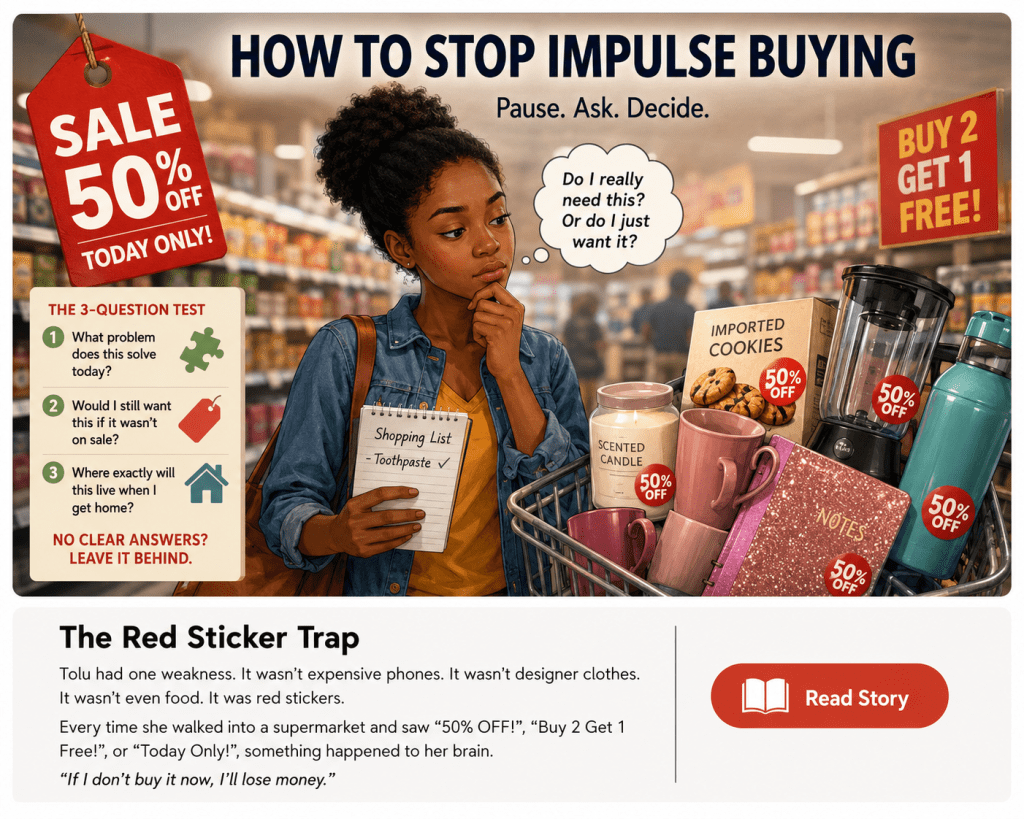
Tolu had one weakness.
It wasn’t expensive phones.
It wasn’t designer clothes.
It wasn’t even food.
It was red stickers.
Every time she walked into a supermarket and saw “50% OFF!”, “Buy 2 Get 1 Free!”, or “Today Only!”, something happened to her brain.
“If I don’t buy it now, I’ll lose money.”
One Saturday, she walked in to buy toothpaste for ₦2,000.
She walked out with:
- A scented candle she’d never planned to buy.
- Three coffee mugs because they were “discounted.”
- Imported cookies she had never tasted.
- A notebook with glitter on the cover.
- A portable blender she didn’t need.
- A fancy water bottle.
Her bill?
₦41,800.
She laughed as she paid.
“At least I saved over ₦20,000 from the discounts.”
Or so she thought.
That evening her older cousin, Chidi, visited.
He noticed the shopping bags everywhere.
“Wow! You bought a blender.”
“I know.”
“You’ve wanted one?”
“No.”
“So why?”
“It was half price.”
He looked around again.
“You also bought candles?”
“They smelled nice.”
“And these mugs?”
“They came as a set.”
“And the cookies?”
“They looked interesting.”
He smiled.
“So…you didn’t actually come home with what you wanted.”
She frowned.
“I did.”
“What did you go there for?”
She paused.
“…Toothpaste.”
The next day Chidi invited her to help him clean his room.
Inside one drawer were dozens of unopened items.
Wireless earphones.
Phone holders.
Gaming accessories.
Water bottles.
LED lights.
Portable speakers.
Exercise bands.
Most were still inside their packaging.
“I bought every one because they were on sale.”
Tolu laughed.
“So you’re just like me.”
“No,” he said.
“I used to be.”
He picked up one unopened phone stand.
“I’ve owned this for two years.”
“You never used it?”
“No.”
“So why buy it?”
“Because I confused cheap with useful.”
Those words stayed in Tolu’s head.
A week later they went shopping again.
This time Chidi handed her a small envelope.
Inside was a plain sheet of paper.
At the top it said:
The Three-Question Test
Whenever something catches your eye, don’t touch your wallet until you answer these three questions:
Question 1
What problem does this solve today?
Not tomorrow.
Not someday.
Today.
If there wasn’t a real problem before seeing the item, the shop probably created one.
Question 2
Would I still want this if it wasn’t on sale?
Discounts can change how our brains judge value.
Take away the bright red sticker.
If the answer becomes “No,” then you weren’t buying the product.
You were buying the excitement.
Question 3
Where exactly will this live when I get home?
If you can’t immediately picture where it belongs…
…you probably don’t need it.
Tolu rolled her eyes.
“This is too simple.”
“Exactly,” Chidi replied.
“Impulse buying happens in seconds. Your defense has to be simple too.”
They entered the supermarket.
Within five minutes she found wireless earbuds.
60% OFF.
Her heart raced.
She reached for them.
Then she remembered the paper.
Problem?
“My current earbuds still work.”
Would I buy them without the sale?
“No.”
Where will they go?
“…Probably in a drawer.”
She slowly placed them back.
It felt surprisingly difficult.
A few minutes later she found imported chocolate.
Limited edition.
Question one.
Problem?
“I’m not hungry.”
Question two.
Would I buy it at full price?
“No.”
Back on the shelf.
Near the checkout was a display of tiny gadgets.
Mini fans.
Pocket flashlights.
Phone rings.
Cable organizers.
Everything under ₦3,000.
Exactly the kind of items that quietly empty wallets.
She smiled.
The questions became easier each time.
At the checkout, her receipt was ₦2,100.
Toothpaste.
A toothbrush she genuinely needed.
Nothing else.
She stared at the receipt.
“This feels…strange.”
Chidi laughed.
“No.”
“It feels intentional.”
Months later, Tolu noticed something unexpected.
Her room wasn’t getting cluttered anymore.
Her wardrobe felt easier to manage.
Her shelves had empty space.
Most importantly…
Her savings account was finally growing.
Not because she had found a better-paying job.
Not because she had stopped enjoying life.
But because she had stopped buying things that only looked exciting for a few minutes.
She realized something that every shop hoped customers would never discover:
A discount doesn’t create value. It only lowers the price.
And something that isn’t useful at full price usually isn’t useful at half price either.
Moral of the Story
Impulse buying rarely starts with needing something. It starts with emotion—excitement, fear of missing out, curiosity, or the thrill of getting a bargain.
A simple way to stop it is to pause before paying and ask yourself:
- What problem does this solve today?
- Would I still buy it if it wasn’t on sale?
- Where will it live when I get home?
If those questions don’t lead to a clear answer, leave the item behind. Most impulses disappear within minutes, but the money you keep can serve you for much longer.
 investment4you
Leave a comment